
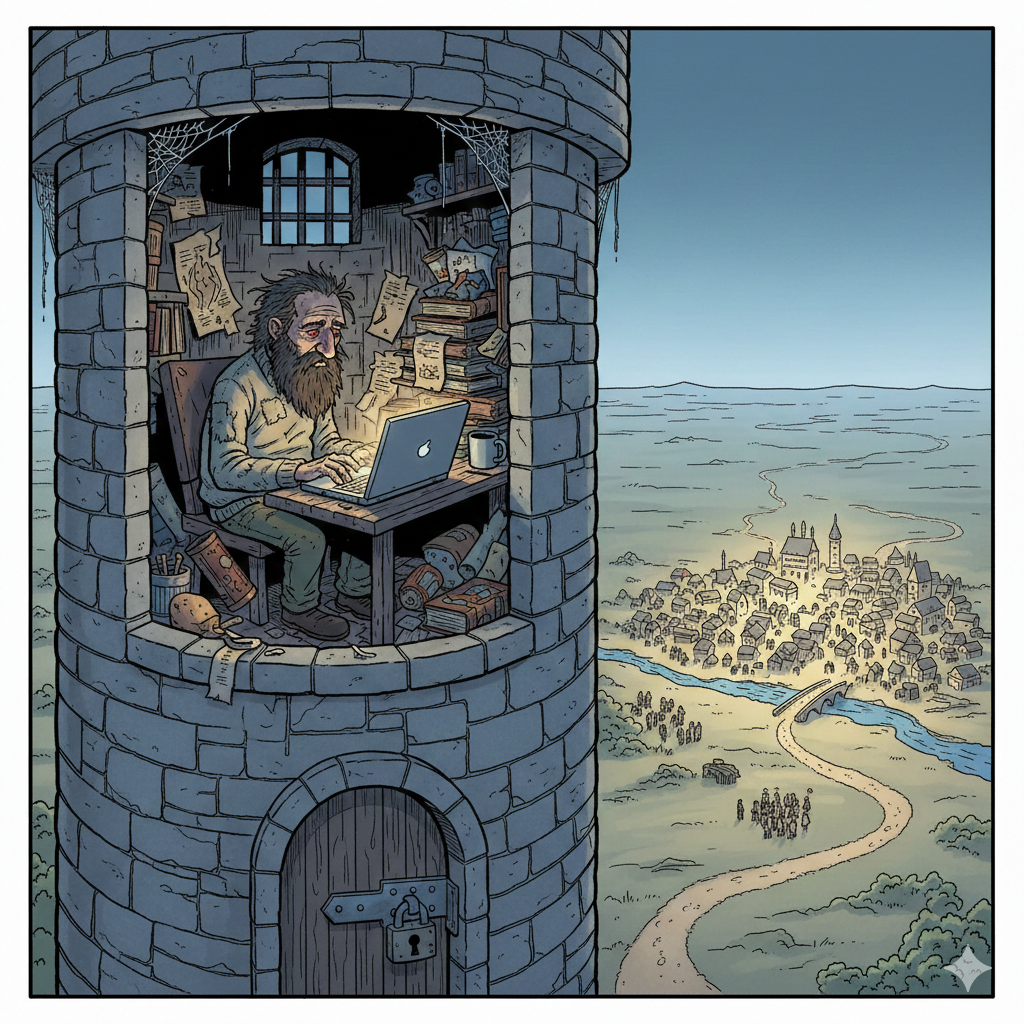
It’s no great revelation that many Americans struggle with social isolation in the ironically named age of “social” media.
Many hopeful career changers find themselves trying to break into not just a new industry, but a new culture that they are an outsider to.
It can be overwhelming—insider jargon you aren’t familiar with, news that you are out of the loop for, and a tight-knit community that doesn’t know you.
Some will avoid this step of integration, but that is a mistake.
Community learning or collaborative learning (as it is often called) as opposed to solo learning can fast track your career change journey by tightening up your feedback loop, giving you direction, and immersion in your target industry’s environment.
Not to mention, networking is everything.
Why Solo Learning Fails
You’re in an Echo Chamber
One of the biggest benefits of community learning is that you can have your course corrected early on. When you spend all of your time learning by yourself, you have nobody to affirm or critique your path.
The result? Without outside input, you might:
- Waste time on skills considered irrelevant, less important, or outdated
- Proceed to advanced topics prematurely with weak fundamentals
- Develop bad habits that professionals immediately flag as problematic
You’re Developing Bad Habits
Is your workflow clumsy? Your workspace disorganized? Your strategy clouded and misinformed?
You’ll never know if you don’t reach out to others in your community.
The result of unchecked bad habits? You’ll be forced to unlearn them, which is much more difficult than not letting them become established in the first place.
You Have No Accountability
We all need somebody who can give it to us straight sometimes. How can you, as a newbie, confidently believe you’re doing all the right things without any feedback?
The truth is: you’re going to work as part of a team. If you cannot integrate into a larger organization, you will not get hired.
You need to:
- Be able to take feedback
- Act on feedback
- Communicate your efforts and thought process
Collaborative learning in an online community is the perfect environment to learn these skills, Youtube tutorials alone will not suffice.
Why Collaborative Learning Works
Research backs up what many career changers discover intuitively: learning in community is significantly more effective than learning alone.
According to a study published in National Library of Medicine, collaborative learning produces better outcomes than individual study across virtually all disciplines and age groups. The researchers found that social learning environments create positive interdependence where learners benefit from each other’s knowledge and perspectives.
Another study from Stanford University’s Graduate School of Education found that students in collaborative learning environments showed 50% greater engagement and persistence compared to those learning independently—a crucial factor when you’re balancing career change with existing responsibilities in your 30s and up.
Here’s what makes collaboraitve learning so powerful:
Faster Feedback Loops
When you share your learning journey with others, you receive feedback quickly. It’s easier to course-correct early on than to go back and fix fundamental mistakes in an otherwise finished project.
Remember, you’re going to be working on a team. You need to learn how to ask for help and how to take feedback.
Exposure to Real-World Applications
It’s hard to understand how what you’re learning applies to the real world, something every teenager learning algebra has lamented.
When you join your industry’s community, you’ll quickly recognize what is and isn’t relevant from your learning.
In my case with marketing, SEO has become a somewhat outdated term in professional circles, but Google Analytics is still very prominent. I wouldn’t know this if I was only learning from the Google Digital Marketing Course.
Accountability That Actually Works
How do you know your website is user-friendly if you have no users? How do you know you have a good job hunt strategy if you never ask someone in your target industry?
It’s good to study on your own, but it’s easy to miss the forest for the trees. You need to build real projects that can be used by real people.
Employers don’t want to see hypothetical projects for theoretical people.
Learning by Osmosis
Industry jargon, news, and trends are waters you’re best steeped in over time.
Joining your industry’s online community is a great way to incorporate all of this into your daily media intake.
While it may be overwhelming at first, after consistent intake, you’ll start to recognize important terms, jargon, and be in the loop about what’s affecting your industry.
This is sometimes referred to as “ambient learning” and is especially championed by those learning new languages.
How Joining a Subreddit Helped My Career Change Journey
After using AI as a career coach, I felt fairly confident that I was on the right track: I built a website, I had 10 SEO-optimized articles done, but something felt off.
Do I just start a website, update my blog, and try to drive traffic? What would actually impress an employer? After all, I’m doing this for a specific reason, not just for fun.
Then I thought, “Why don’t I just ask?”
So I searched “digital marketing” on Reddit and found a subreddit full of digital marketers. The user base includes both those trying to break into the industry and long-time veterans.
I made a post: “Newbie Here, Can Anybody Give Me Advice?”
In my post, I explained that I was only a month into my learning, and that while I felt pretty confident taking the Google Digital Marketing Course and following Claude AI’s career advice, I really needed a professional’s input.
Lucky for me, I received a reply shortly after. The poster commented that while I was certainly on the right track, I didn’t want to get stuck playing maintenance with a personal site.
He advised me to choose a metric, track it, and try to increase it. He offered other advice as well: to offer a downloadable file and try to drive conversions.
“What employers care about seeing more is that you understand the feedback loop we work with,” he told me.
“Employers want to see that you can do a competent case study, analyze what’s working, what’s not, and adjust to hit a goal.”
“If you can do that, you will be far beyond the majority of entry-level applicants” he assured me.
That advice was immensely helpful to me, and I immediately pivoted my efforts and created the Career Change Toolkit.
The timeline matters: I had spent three weeks building content in isolation. Within 24 hours of posting in the community, I had direction that would have taken me months to figure out on my own, if I ever figured it out at all.
How to Find and Use Online Communities for YOUR Career Change
You’re likely already an active member of an online community. Nearly any social media platform you can think of will have your target industry represented.
Whether you’re most comfortable with Facebook, Discord, Slack, LinkedIn, or Instagram—really any social media platform—you can simply type your industry into the search function.
From there, you should see posts relating to your field, users who are part of the community, subreddits, and pages to follow.
But here’s where most people stop. They find the community, lurk for a few weeks, and never engage. Don’t make that mistake.
Where to Find Industry Communities
Reddit is excellent for most industries. Search “[your industry] reddit” and you’ll find dedicated subreddits. The upvote system helps quality content and advice rise to the top. The userbase is very active so you have high chances of getting responded to if you post.
Discord and Slack communities often cater to specific niches within industries. Search for “[your industry] Discord server” or look for Slack communities through directories like Slofile.com. These options can be a little more casual for conversing as they feel more like chatrooms than forums (such as Reddit).
LinkedIn Groups tend to be more professional and polished. They’re particularly useful for B2B industries and more traditional career paths.
Niche Forums still exist for many industries—software developers have Stack Overflow, designers have Dribbble and Behance communities, writers have Absolute Write, and nearly every industry has at least one active forum if you search for it.
Facebook Groups can be surprisingly active for certain industries, particularly those with older demographics or local focus.
How to Evaluate if a Community Is Right for You
Not all communities are created equal. Before investing time, evaluate:
Activity level: Are posts from the last week visible? Do posts get meaningful responses, or do they sit ignored?
Quality of discourse: Are people helpful and constructive, or hostile and elitist? Read through several threads to get a feel for the culture.
Mix of experience levels: The best communities have both beginners and veterans. If it’s all beginners, you won’t get expert guidance. If it’s all experts, you might feel unwelcome.
Relevance to your goals: Is this community focused on practitioners doing the job you want, or is it mostly people trying to sell courses and services?
Best Practices for Engagement
Give before you take. Spend your first week or two just reading and upvoting/liking helpful content. When you see questions you can answer, even partially, contribute. This builds goodwill before you ask for help.
Ask smart questions. Don’t just say “How do I break into marketing?” Instead: “I’ve completed [specific course], built [specific project], and I’m targeting [specific role]. Based on my situation, should I focus on Google Ads or SEO next?”
Share your work. Post your projects, portfolio pieces, or case studies and ask for specific feedback. “What would make this more hireable?” is a question people love to answer.
Document your journey. Regular updates about your progress (“Week 4 of my career change: here’s what I learned”) often attract helpful advice and keep you accountable.
Follow up. When someone gives you advice, implement it, then report back on the results. This closes the feedback loop and makes people more likely to help you again.
How to Avoid Common Pitfalls
Don’t lurk forever. Two weeks of observation is enough. After that, you’re just procrastinating. Make your first post.
Don’t be too passive. Consuming content is fine, but transformation happens when you participate. Set a goal: one meaningful comment or post per week minimum.
Don’t take every piece of advice. You’ll get conflicting opinions. Look for consensus among experienced members, and when in doubt, ask follow-up questions about why someone recommends what they do.
Don’t ignore your instincts. If advice feels wrong for your situation, it might be. Explain your reservations and ask for clarification. Good communities will help you think through your specific context.
Don’t let it become a time sink. Set boundaries. Maybe you check in for 20 minutes every morning with coffee, or 30 minutes on Monday, Wednesday, Friday. Community learning should accelerate your progress, not replace it.
Addressing Common Concerns
“I’m too old to ask beginner questions.”
You’re not. Most communities are remarkably welcoming to career changers precisely because many members have been in your shoes. Lead with your context: “Switching to data analysis at 35, probably a basic question but…” People respect the courage it takes to start over, and your life experience often brings valuable perspectives that younger learners lack.
“I don’t have time for another online community.”
You don’t need to live there. Fifteen minutes a day is enough, which is less time than you probably spend on social media already. Replace some mindless scrolling with intentional community engagement. Post a question while your coffee brews. Read a few threads during lunch. The key is consistency, not quantity.
“What if the advice is bad?”
Bad advice exists, but communities have built-in quality control. On Reddit, poor advice gets downvoted. In active Slack or Discord communities, other members will quickly correct misinformation. Look for consensus among experienced members, ask for reasoning behind recommendations, and cross-reference major decisions. Over time, you’ll develop the judgment to distinguish good advice from noise.
Trust the process, your critical thinking skills haven’t disappeared just because you’re learning something new.
Conclusion: Your Next Steps
Changing careers in your 30s is challenging enough without doing it in isolation. Online communities provide the direction, feedback, accountability, and insider knowledge that accelerate your transition from months to weeks.
The research is clear: learning in community produces better outcomes than learning alone. But more importantly, your outcomes will be better. You’ll avoid costly mistakes, build relevant projects, develop industry connections, and gain confidence faster than you would studying solo.
Here are your specific next steps for today:
- Identify your community. Search “[your target industry] reddit” or “[your target industry] discord” right now. Join at least one community.
- Observe for one week. Read posts daily. Notice what questions get good responses, how people help each other, and what the culture feels like.
- Make your first post. Introduce yourself, share where you are in your journey, and ask one specific question about your learning path or strategy.
- Set a recurring calendar reminder. Block 15-20 minutes three times per week to engage with your community. Make it a non-negotiable part of your career change routine.
You’ve already shown courage by deciding to change careers. Now multiply that effort by learning in community. The people who’ve succeeded in your target field are already there, waiting to help someone like you. All you have to do is show up and ask.
Your next career starts with your next conversation. Go start it.