
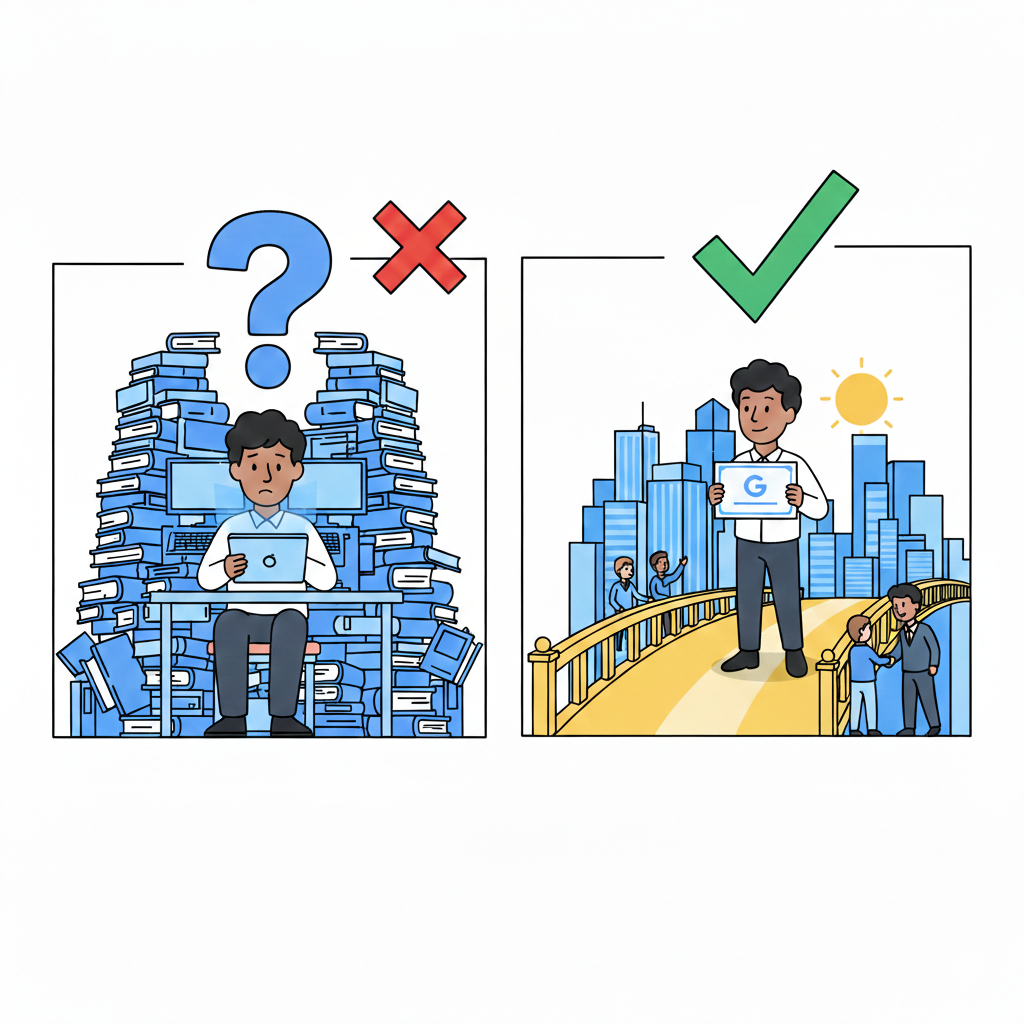
I spent three weeks completing the Google Digital Marketing Certificate hoping it would help me land an entry-level marketing job. Here’s what I actually learned, what employers think about it, and whether it’s worth your time
- Addressing the Elephant in the Digital Marketing Course
- The Google Digital Marketing Certificate Course Might Not Be Worth Your Full Attention
- The Content and Format Feels Outdated
- My First Project was my Last Red Flag
- When I Realized the Google Certificate Wasn't Enough
- There are More Efficient Ways to Learn
- Why You Will Learn More From a Portfolio than the Google Digital Marketing Course
- So, Is the Google Digital Marketing Certificate Worth The Trouble? The Honest Pros and Cons
- Can You Get a Job With a Google Certificate? Here's What the Data Says
- Should You Take the Google Digital Marketing Certificate?
- Frequently Asked Questions About the Google Digital Marketing Certificate
Addressing the Elephant in the Digital Marketing Course
Are you trying to pivot careers in your 30s? That’s what I’m doing, and that’s how I found myself enrolled in the Google Digital Marketing course on Coursera.
I have been going through the material at a rapid pace. Google states that the course will take you anywhere from three to six months. I am currently set to finish it in about two.
If your journey has been anything like mine, you’ve been led to believe that obtaining the Google Digital Marketing Certificate is your first step on your new career path.
Indeed, most signs on the internet point to the Google certificate as your golden ticket to a dream job.
In fact, it’s the first thing that comes up when you search “where to start a career change in digital marketing.”

While I’m not trying to rush through the learning process, I am trying to land a job by the beginning of Spring 2026.
That led me to ask myself: Is the Google Digital Marketing Certificate worth all this time and effort?
The more I pondered the question, and slogged through video after video, the more a nagging thought developed in my head:
I don’t think this is going to get me hired.
The Google Digital Marketing Certificate Course Might Not Be Worth Your Full Attention
I started the course as eager as anyone else who has the motivation to make a big change in their life.
Ready to learn and full of energy, I watched every video, paying attention as best I could, I took thorough notes, and completed each test between sections.
It was difficult to pay attention, I won’t lie. When I am learning a new skill, I prefer to read a book or have one-on-one time with a tutor/instructor.
Watching video after video of somebody reading off a script that I could read in half the time felt, well, boring.
Moreover, it felt like an inefficient use of my time.
I’m sorry, but the marketing funnel is not that complicated a concept; it’s not nuclear physics.
As I continued, I not only found issues with the video course format, but also with the assessment process.
Frankly, the tests are easy. Too easy.
After completing a few tests, they take on a predictable pattern.
For example, in every test there’s always a “select all statements that apply” question with three obviously correct answers and one comically wrong one.
Below is a screenshot from an actual test in the course.

Let me be frank:
Most people could pass these tests without watching a single video.
I completed the first course in a week and moved on to course two: “Attract and Engage Customers with Digital Marketing.”
“Oh, good,” I thought. “Now I’ll learn hard skills like how to drive traffic, retain customers, you know…actually market something.”
Nope.
The Content and Format Feels Outdated
Something everyone who works in tech and tech-adjacent fields knows is this: things change constantly.
As such, it was hard to ignore the subtle indicators of this course’s age.
For example, the speakers kept referring to the website “X” as “Twitter” (the name changed two years ago).
Another sign that perturbed me was the fact that the modules seemed to lack any substantial information on how AI has disrupted and changed the field.
For instance, I know from watching YouTube videos of industry professionals that SEO has changed significantly since the time this course was created.
I know the course is supposed to be a general overview and introduction to digital marketing; however, it seems like a disservice not to include anything about SaaS or Google’s new ranking system and semantic search.
Despite my doubts, I persisted.
My First Project was my Last Red Flag
Finally, the first hands-on assignment of the course: analyze a table of customer data and craft two customer personas. I did my best to go above and beyond, thoroughly demonstrating that I’d understood the material.

When I finished, I clicked to the next page to submit my work.
At the very bottom of the page was one little checkbox. Instructions: check this box to confirm you completed the assignment. No option to upload a file, not even a place to copy and paste my writing.

That’s it? Nobody’s checking my work? We’re on the honor system?
I could’ve skipped the entire assignment, guessed on every test, and nobody would have known the difference.
That’s when it hit me:
If I can see these shortcomings after just one course, then employers definitely know the limits of the Google Digital Marketing Certificate.
When I Realized the Google Certificate Wasn’t Enough
While looking for alternative routes to supplement my learning, I came across a one-day class on using AI as a personal assistant
“What the hell,” I thought. “AI is clearly the future, and this will probably be more valuable than the entire first Coursera course.”
The class was hands-on and practical, and while I was learning about all of AI’s capabilities, I had a lightbulb moment: AI could be a powerful coach for my career change.
So I asked Claude to help me build a strategic plan to learn digital marketing and land a job by the end of winter.
Its first advice?
Deprioritize the Coursera Google certificate.
“If anything, watch the videos at two times speed and skim the readings.”
Why?
“Because everyone you’re competing with has the same certificate. When an interviewer asks about your experience, all you’ll be able to say is, ‘I took a class.’”
There are More Efficient Ways to Learn
I realized I could learn far more efficiently with AI as a study partner and career coach. It gives constant and thorough feedback. I can ask pointed questions, even “dumb” ones that might waste a paid professional’s time, and at a price tag of $20 a month, its value is a no-brainer.
Claude told me that I am better off creating my own website, my own blog, and my own email marketing campaign. It even suggested that when it’s time, I could experiment with running my own paid advertising too.
This is all hands-on experience that shouldn’t wait until you have a job to start implementing.
What better way to learn than by doing?
Now, not only am I learning how to make SEO Content, use Google Analytics, and make Email Sequences, but I’m actually getting hands-on experience and live feedback from Google Analytics on the back end. The result is a holistic education in how digital marketing works.
This is the way, friends.
With a “portfolio first” approach, my experience, experiments, and work ethic take center stage, not a certificate that shows you can sit through hours of videos.
The Google Digital Marketing Course will never be able to simulate the tediousness of trying to fix your website layout on wordpress!
Here’s a screenshot of the SEO analytics of my blog so far

Why You Will Learn More From a Portfolio than the Google Digital Marketing Course
Before I rip into the Google Digital Marketing course too much, I will say that it is worth something, so don’t get me wrong.
The course helps you learn key concepts and business jargon, especially if you’ve never been exposed to them before.
What it doesn’t do is facilitate hands-on experience, and without hands-on experience, your certificate won’t get you hired.
Constructing a portfolio will teach you by doing.
Instead of memorizing what a meta description is, you will actually write it, see where to plug it in, and understand how it’s actually implemented.
Through this approach, I built this blog you are reading now. I have been using SEO optimization to drive traffic while focusing on making my blog content as authoritative and helpful as possible to appease AI searches (something the course does not cover).
This is relevant experience. A portfolio will say more to employers than a Google certificate ever will on a resume.
Even if my blog doesn’t succeed, I’ll learn from what went wrong.
So, Is the Google Digital Marketing Certificate Worth The Trouble? The Honest Pros and Cons
To be fair, the Google Digital Marketing Certificate wasn’t completely useless.
What was actually useful:
- It helped me understand common jargon.
- It taught me commonly used acronyms like PPC, CPC, and SEM.
- It introduced useful concepts like “the customer journey” and “touch points.”
What wasn’t worth the time:
- I could’ve learned these concepts faster by talking to AI or reading a textbook.
- Long winded videos failed to keep me engaged.
- The fact that the tests could be guessed through and the projects don’t get graded doesn’t inspire confidence in the course.
Can You Get a Job With a Google Certificate? Here’s What the Data Says
Don’t just take my word for it, I did some research on the topic, and here’s what I found:
Portfolios are Effective
- According to a 2023 study by Adobe, 59% of hiring managers prefer visual resumes like portfolios over traditional text-based resumes.
- Research published in the Journal of Work-Applied Management states that 73% of small business employers and 82% of large business employers believe portfolios help job applicants in the hiring process.
Demonstrated Competency Trumps Certificates Alone
- The 2023 State of Skills-Based Hiring report from TestGorilla found that over 70% of employers consider skills-based hiring tools—including work samples and portfolios—to be effective.
- From the same report: 86% of job candidates reported that the opportunity to showcase role-relevant skills increased their likelihood of securing their target job.
Google Certificates are Not Worthless
- Google reports that 75% of their Digital Marketing & E-commerce Certificate graduates experience a positive career outcome (new job, promotion, or raise) within six months of completion
Despite my complaints, the Google Digital Marketing Certificate is still the standard within the industry
What Industry Professionals Say
Matt Erhard, Managing Partner at Summit Search Group, puts it bluntly:
“Candidates who can demonstrate real experience leading teams and taking ownership of projects will always stand out the strongest.”
Deepak Shukla, CEO of Pearl Lemon Placements, notes that:
[while certificates are] “making an impression” [with hiring managers, they’re most effective] “when paired with real-world project samples or freelance work.”
The consensus among hiring professionals is clear:
Certifications can open doors, but portfolios close deals.
This Reddit comment sums it up nicely

Should You Take the Google Digital Marketing Certificate?
If you’re considering the Google Digital Marketing Certificate, here’s what I’d tell you: the course is more of a formality than an efficient learning tool. It helps to have, but it’s close to useless if you don’t have a portfolio or demonstrated work experience to back you up.
To those of you who are Googling “is the Google Digital Marketing Certificate worth it” at 2 am, here’s my answer: it’s a decent foundation, but it won’t get you hired on its own.
For any of you who are already enrolled in the Google Career Certificate, don’t stop there. Use it as a foundation, not a finish line.
When you walk into an interview, you won’t just need a certificate.
You’ll need proof you can execute, and that only comes from building something real.
Frequently Asked Questions About the Google Digital Marketing Certificate
Is the Google Digital Marketing Certificate worth it?
It depends on your goals. For learning basic jargon and concepts, yes. For getting hired without additional portfolio work, no. The certificate provides a foundation, but you need hands-on projects to stand out from the thousands of other people who have the same credential.
How long does it take to complete the Google certificate?
Google estimates 6 months at 10 hours per week. I completed the first course in one week, but that’s without a full-time job. The bigger question is whether spending 6 months on the certificate is the best use of your time compared to building a portfolio. If you are on any kind of time constraint, it’s likely not worth it.
If possible, you should skim through it, take the tests, and get the certificate. The value isn’t necessarily in the education, but in the certificate itself.
Can you get a job with just the Google Digital Marketing Certificate?
Unlikely. Thousands of people have this same certificate. You need portfolio work that demonstrates your actual abilities to stand out in job applications. When interviewers ask about your experience, “I completed an online course” isn’t a compelling answer.
Is the Google certificate recognized by employers?
Employers recognize it exists, but they care more about demonstrated skills and portfolio work. The certificate proves you understand basic concepts, but it doesn’t prove you can execute marketing campaigns, analyze data, or produce results.
Should I finish the Google certificate or focus on building a portfolio?
Build a portfolio first. Use the certificate as supplementary reference material, not your primary learning method. Employers hire based on what you can do, not what courses you’ve completed. Use an AI to walk you through the process if you feel lost.