
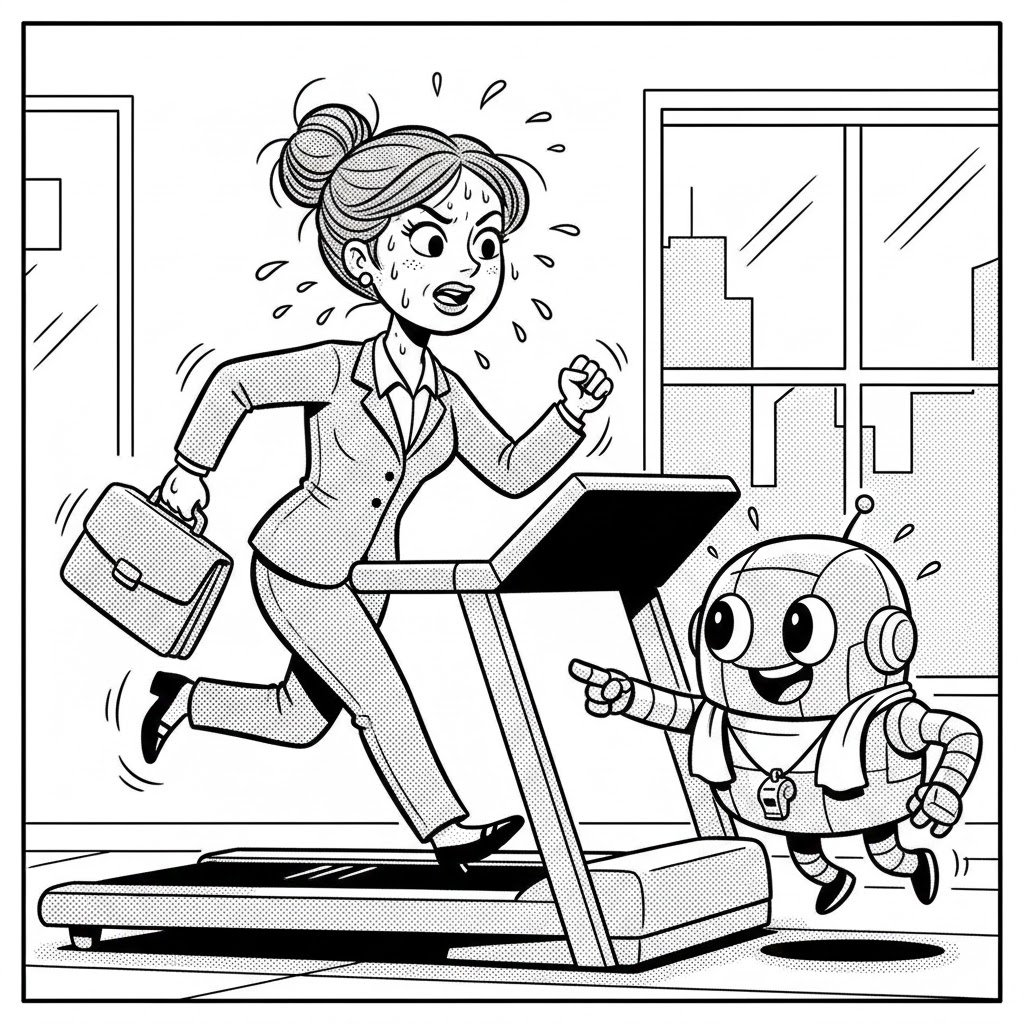
Six weeks ago, I had no idea what direction to take in my career change. I knew I wanted out of restaurants, but I didn’t know where I fit in digital marketing or how to get there.
Then I started using AI as my career coach, and everything changed.
Not because AI did the work for me, but because the right prompts helped me think more clearly, move faster, and avoid spinning my wheels.
Here are the 10 specific prompts that actually helped me change careers. Copy them, customize them for your situation, and use them.
- How to Use These Prompts
- Prompt #1: Find Your Career Direction
- Prompt #2: Validate Your Career Choice
- Prompt #3: Build Your Learning Plan
- Prompt #4: Identify Your Transferable Skills
- Prompt #5: Mentoring When You Have Doubts
- Prompt #6: Generate Content Ideas
- Prompt #7: Get Unstuck When Overwhelmed
- Prompt #8: Reality-Check Your Timeline
- Prompt #9: Brainstorm When You're Stuck
- Prompt #10: Stay Accountable
- How to Customize These Prompts
- What These Prompts Can't Do
- The Most Important Prompt (That I Didn't List)
- Why This Actually Matters
- Start With One Prompt Today
How to Use These Prompts
Before you start:
- Choose your AI (ChatGPT, Claude, Gemini, they all work)
- Start a fresh conversation for each major topic
- Don’t just copy/paste blindly; customize with YOUR details
- Push back when answers don’t feel right
- Use follow-up questions to dig deeper
These prompts work because they use “reverse prompting”; Instead of asking AI to give you answers, you ask it to interview YOU. This generates better, more personalized results.
Prompt #1: Find Your Career Direction
The Prompt:
I'm considering a career change but I'm not sure what direction to take. Ask me 10 questions to help me figure out what type of work would fit my skills, interests, and circumstances. Ask one question at a time and wait for my response before asking the next.Why it works: Most people ask AI “What career should I choose?” and get generic garbage. This prompt makes AI interview you, which surfaces insights you didn’t know you had.
What you’ll get: AI will ask about your natural strengths, what drains vs. energizes you, financial constraints, lifestyle preferences, and past experiences. By the end, you’ll have a clearer picture of realistic options.
My result: This prompt led me to SEO content marketing instead of generic “digital marketing.” It identified that I should focus on writing-heavy roles given my background and preferences.
Prompt #2: Validate Your Career Choice
The Prompt:
I'm thinking about switching from [current field] to [target field]. Challenge this decision. What are the biggest risks, downsides, and potential problems I should consider? Be brutally honest.Why it works: AI defaults to being encouraging. This prompt forces it to play devil’s advocate, which helps you stress-test your decision before committing. It’s also always helpful to prompt the AI not to be too sycophantic.
What you’ll get: Realistic concerns about salary cuts, skill gaps, competition, time investment, and whether your expectations match reality.
My result: AI pointed out that digital marketing is saturated, I’d likely take a pay cut initially, and I’d be competing with people who have formal training. All true, but knowing this upfront helped me prepare rather than being blindsided.
Prompt #3: Build Your Learning Plan
The Prompt:
I want to transition from [current field] to [target field] in [X months]. I have [Y hours per week] to dedicate to learning. Create a week-by-week learning plan with specific skills to focus on, resources to use, and milestones to hit.Why it works: Vague goals like “learn digital marketing” lead nowhere. This prompt forces specificity: what to learn, when, and how to measure progress.
What you’ll get: A structured timeline breaking down the overwhelming task into manageable weekly chunks with clear objectives.
My result: AI mapped out my 12-week plan: Weeks 1-4 for portfolio building, Weeks 5-6 for website setup, Weeks 7-12 for job applications. Without this structure, I’d still be randomly taking courses.
Prompt #4: Identify Your Transferable Skills
The Prompt:
I worked as a [job title] for [X years]. I want to transition to [new field]. Interview me about my previous work to identify transferable skills that would be valuable in my new field. Ask me specific questions about what I actually did day-to-day.Why it works: You can’t see your own transferable skills clearly. This prompt helps AI extract the valuable stuff buried in your “irrelevant” experience.
What you’ll get: AI will dig into your actual responsibilities and translate them into skills relevant to your new field.
My result: This entire article came from this prompt. AI helped me see that restaurant work taught me customer psychology, communication under pressure, and systems thinking—all valuable for marketing.
Prompt #5: Mentoring When You Have Doubts
The Prompt:
I'm experiencing [anxiety, doubts, frustration etc.] about changing careers. I feel like [specific fear/doubt]. Challenge this thinking. What evidence contradicts this belief? What would I tell a friend in this situation?Why it works: We can get stuck in our echo chambers of self doubt. This prompt forces you to externalize and examine your fears logically.
What you’ll get: A reality check that separates real concerns from irrational fears, plus perspective shifts that reduce anxiety.
My result: When I felt “too old at 34,” AI helped me see that the average career changer is 39, that I have 30+ years of career left, and that my age is actually an asset (maturity, professionalism) not a liability.
Prompt #6: Generate Content Ideas
The Prompt:
I'm building a portfolio blog about [topic]. Interview me about my experiences with [specific area] to help generate 10 unique article ideas. Ask me questions about specific moments, challenges, lessons learned, and turning points.Why it works: Staring at a blank page asking “what should I write about?” is paralyzing. This prompt mines your actual experiences for content gold.
What you’ll get: Specific, unique article angles based on your real story; not generic listicles anyone could write.
My result: This prompt generated ideas like “No, 30 Is Not Too Old to Change Careers (Stop Being Dramatic, Start Being Practical)” and “Why I’m Done Chasing Passion”—angles nobody else is writing about.
Prompt #7: Get Unstuck When Overwhelmed
The Prompt:
I'm feeling overwhelmed by [specific situation]. Break this down into the smallest possible next step I can take in the next 30 minutes. Don't give me a big plan, just tell me the ONE thing I should do right now.Why it works: When you’re overwhelmed, your brain freezes. This prompt cuts through the noise and gives you immediate action.
What you’ll get: One concrete, doable task that creates momentum.
My result: When I felt paralyzed about “building a portfolio,” AI said: “Open a Google Doc and write 3 bullet points about why you’re changing careers.” That’s it. Fifteen minutes later, I had the foundation of my first article.
Prompt #8: Reality-Check Your Timeline
The Prompt:
I want to achieve [goal] in [timeframe]. Based on what's realistic for someone in my situation, is this timeline achievable? If not, what's a more realistic timeline and why?Why it works: Unrealistic timelines kill motivation when you inevitably fall behind. This prompt calibrates your expectations.
What you’ll get: Honest assessment of whether your timeline makes sense, plus adjusted timelines with reasoning.
My result: I wanted to be job-ready in 4 weeks. AI told me 12 weeks was more realistic for building a portfolio + website + starting applications. Being right about timing matters more than being fast.
Prompt #9: Brainstorm When You’re Stuck
The Prompt:
I'm working on [specific project] and I'm stuck on [specific problem]. Don't solve it for me. Instead, ask me 5 questions that will help me think through this differently.Why it works: AI giving you answers makes you dependent. AI asking you questions makes you smarter.
What you’ll get: Probing questions that shift your perspective and help you solve the problem yourself.
My result: When I was stuck on article structure, AI asked: “Who is this article for?” “What’s the ONE thing they need to walk away knowing?” “What’s the most interesting part of this story?” These questions unlocked the article.
Prompt #10: Stay Accountable
The Prompt:
I'm trying to [goal] and I'm considering [distraction/deviation]. Should I do this, or should I stay focused on my original plan? Be honest about whether this is a good strategic move or just me getting distracted.Why it works: We’re terrible at objectively evaluating our own ideas. This prompt gives you an outside perspective when you need it most.
What you’ll get: A reality check on whether your new idea is actually good or just shiny object syndrome.
My result: When I wanted to start a gaming blog alongside my career change blog, AI said: “No. You have 12 weeks to get hired. Every hour on gaming content is an hour not spent on your goal. Stay the course.” I needed to hear that.
How to Customize These Prompts
Don’t just copy/paste verbatim. Make them yours:
Replace brackets with your details:
- [current field] → “restaurant management”
- [target field] → “digital marketing”
- [X months] → “3 months”
- [specific problem] → “I don’t know what to write about”
Add context: After the prompt, add: “For context: [your specific situation]”
Set boundaries: Add to any prompt: “Be direct and concise. Don’t be overly encouraging—I need honest feedback.”
Follow up: If the first answer isn’t helpful, say: “That’s too vague. Give me specific examples” or “Can you dig deeper into [specific part]?”
What These Prompts Can’t Do
Let me be clear about limitations:
AI prompts won’t:
- Make career decisions for you
- Do the actual work of changing careers
- Replace talking to real people in your target field
- Guarantee you’ll succeed
- Eliminate all uncertainty and fear
AI prompts will:
- Help you think more clearly
- Save you time on planning and organizing
- Give you structure when you’re overwhelmed
- Challenge your thinking when you need it
- Keep you accountable to your goals
The prompts are tools. You still have to swing the hammer.
The Most Important Prompt (That I Didn’t List)
Here’s the meta-prompt that makes everything else work:
I'm using you as a thinking partner for my career change, not as someone to do the work for me. When I ask questions, challenge my assumptions, ask me follow-up questions, and help me think more clearly. Don't just give me answers, help me figure out the right questions to ask.Use this at the start of any AI conversation about your career. It completely changes the dynamic from “AI gives answers” to “AI helps you think.”
Why This Actually Matters
According to National Association of Colleges and Employers, “Less than one-third of graduating seniors in the Class of 2025 said they used it in their job search” however career centers are utilizing AI more and more to help in career planning and job hunting.
Utilizing AI as a career coach saves you time, and as of this writing, you are still ahead of the curve by taking advantage of it’s abilities.
These prompts work because they:
- Force specificity instead of vague advice
- Make AI interview you instead of lecturing you
- Challenge your thinking instead of validating it
- Give you structure without doing the work for you
Start With One Prompt Today
Don’t try to use all 10 at once. Pick the one that addresses your biggest current pain point:
- Stuck on direction? → Use Prompt #1
- Doubting your choice? → Use Prompt #2
- No clear plan? → Use Prompt #3
- Can’t see your value? → Use Prompt #4
- Impostor syndrome? → Use Prompt #5
- Don’t know what to create? → Use Prompt #6
- Feeling overwhelmed? → Use Prompt #7
- Unrealistic timeline? → Use Prompt #8
- Stuck on a problem? → Use Prompt #9
- Getting distracted? → Use Prompt #10
Copy one. Paste it. Customize it. Use it.
Then come back for the next one when you need it.
That’s how I’m changing careers. One prompt at a time.